
Hope, Resilience, and Real Life: How to Keep Going When the Future Feels Unclear
Read the full conversation and insights from this episode
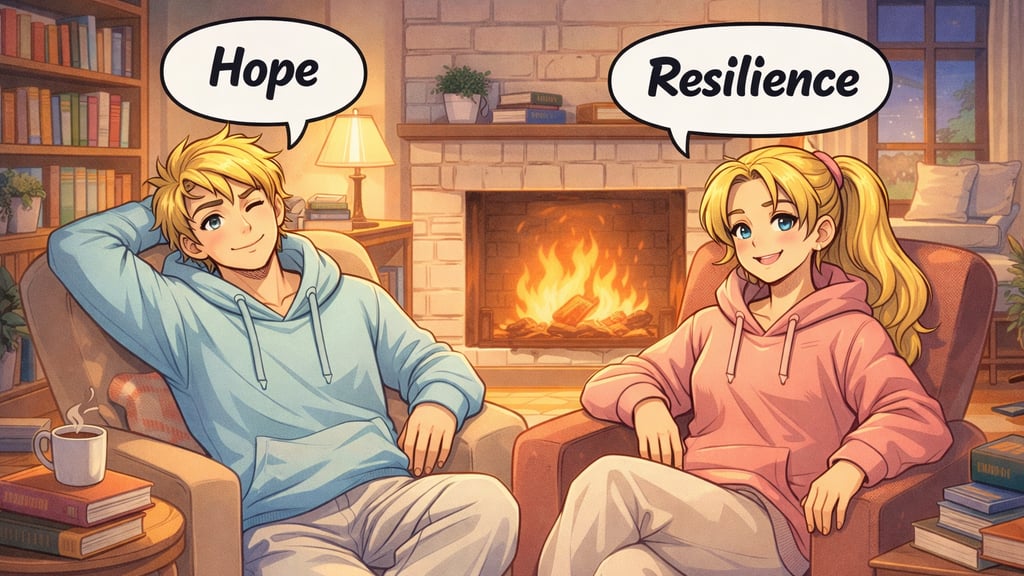
Chris & Jen in the Morning | Season 2, Episode 2: Hope, Resilience, and Real Life
Show Title: Chris & Jen in the Morning
Season: 2
Episode: 2
Title: Hope, Resilience, and Real Life: How to Keep Going When the Future Feels Unclear
Tagline: Where Self-Care Meets Real Life
Hosts: Chris & Jen
Producer / Husband: Ace Gere
🎧 Episode Overview & Key Topics
**** Episode Welcome & A Special Birthday Shout-out to Ace
**** Gratitude Segment: The Power of Chris's Hype & Feel-Good Playlists
**** Jen's Gratitude: Celebrating 21.5 Years of Marriage to Ace
**** Grappling with Tension, Uncertainty, and Division in the United States
**** Defining Hope as an Action with an Asterisk vs. Fear of Despair
**** Anime Inspirations: My Hero Academia, All Might, and Internalizing the Hero Archetype
**** The Psychology of Isolation: The Comfort and Danger of Staying Home
**** Neuroscience Nugget: The Negativity Bias and prolonged Nervous System Fatigue
**** The Critical Difference: True Hope vs. Wishful Thinking and Coping Mechanisms
**** Deep Dive: Jen Shares Her Raw 10-Year Infertility and IVF Journey
**** The Damage of Toxic Platitudes: Why "It Wasn't Ment to Be" is Harmful
**** Neuroscience Nugget: Brain Certainty vs. True Hope’s Tolerance of Ambiguity
**** Leadership Lessons: Learning to Focus on Response Control Rather Than Outcomes
**** Finding Balance: How to Share Real Struggles Without Moving Into Despair
**** Building the Resiliency Muscle: Squishy Ground vs. Solid Ground
**** Finding Stability: Anchoring Internal Values Over External Chaos
**** Pop Culture Analysis: Shifting from Fixing to Kindness in Everything Everywhere All at Once
**** Final Advice: Finding Quiet Hope and Choosing Not to Disappear
**** Community Wrap-up, New Contact Channels, and Subscription Details
📝 Full Transcript
- Welcome & Birthday Shout-Outs
Jen (00:00)
Welcome to Chris and Jen in the morning.
Chris (00:02)
Where Self-Care Meets Real Life. I'm Chris.
Jen (00:06)
I'm Jen and we are excited to be here today.
Chris (00:09)
Welcome back everybody.
Jen (00:12)
We're gonna talk about hope and resilience and what those mean to us today. But before we get to all of that, we have to do a huge... special shout out to the producer because today, the day that we are recording this, is his birthday.
Chris (00:31)
Happy birthday, Mr. Producer!
- Gratitude Segment: The Inspirational Playlist
Jen (00:35)
I think we want to also just hop quickly into gratitude moments because I love this segment of our podcast. So let's talk about what we have to be grateful for, which is so many things. And Chris, why don't you start us?
Chris (00:50)
Okay, this week has been a tough week, as we will talk about, and it's been a lot. And I have shared with you before and on this podcast, like, music is so important to me. And I have found that music can really help shift my perspective, my attitude, kind of the energy that I take into the day. And so usually I—lately I've been listening to a lot of audiobooks.
Jen (00:54)
It has been a tough week.
Chris (01:13)
And I have—as I found myself more in this like mood and space that I didn't really care to be in, I kind of put some thought into, okay, why am I here? What's happening? And how can I like pull myself back from it? And I was like, let's put together a feel-good playlist. And so throughout the week, I've just kept adding songs to it and have moved through my week. And it really does just help me like move through the world more hopeful, more excited, and yeah, I am grateful to all of the wonderful artists who bring great inspirational music to the scene that can reach out through speakers and touch lives. See, this is why I did the pre-work, because I knew you were going to ask that question.
Jen (01:55)
What's on your playlist? Uh-huh. 'Cause you knew I was going to ask you this question. What's on your playlist?
Chris (02:02)
Yes. So of course we talked about it last week. My number one song on it is "Fight Song." That's the one that kind of got it started. And then your song was the natural second one: "I'm the Man" by Aloe Blacc. It is—it's a great hype song. Sia's "Unstoppable"—love that song. "One Moment in Time" by Whitney Houston.
Jen (02:09)
Yes, love that. Love "I'm the Man," Aloe Blacc. That is a really good hype song. This is a great hype song. Love that. Okay, all right, as performed...
Chris (02:31)
As performed by Whitney Houston—don't think she wrote it. "Don't Stop Me Now," Queen. I hadn't really thought about the words of that song. It came up as—yes, that exact one. And so that has made it onto the playlist. We talked about this one a little bit earlier: "Instrument of Peace" by The Tenors, who used to be known as the Canadian Tenors. I don't know if they still go by that. I think it's The Tenors, anyways. And then...
Jen (02:40)
Right now. I love that.
Chris (02:56)
"What It Sounds Like" from K-Pop Demon Hunter is also another—I think that is a, yes, very underrated song in that entire soundtrack. "I Am Here" by Pink and "Where We Go" by Pink. Love, love, yeah.
Jen (03:00)
This is what it sounds like. Yes. Yes. Just Pink in general. Doesn't matter what she's singing. She just lifts me up.
Chris (03:17)
A throwback to some people may remember this one: "Hold On" by Wilson Phillips. Love that one. Try—
Jen (03:23)
Oh yeah, yeah, yeah, yeah. They are more of that like bluegrass kind of a thing, right?
Chris (03:30)
Yeah, but there—I mean, it's definitely got a little bit of a bop to it. And so I really like that one.
Jen (03:33)
Yeah, yeah, yeah, it's boppy. Boppy, bluegrass is boppy. It's a bop.
Chris (03:37)
Yeah, it can be. And then "Try Everything" by Shakira—I've talked about that one. Love that song. It should have, yeah, my inspirational playlist. The other one, and this is like why I say like as I go through the day or the week and I just like continue to add to it. I came across a clip on like social media somewhere of Jennifer Hudson singing "The Impossible Dream," or it's also known as "The Quest." And I don't really know what you were just singing, but I don't think so. But it's like the song builds throughout the entire thing. And so when she—
Jen (03:42)
Yes, it should have. This should have been a guessing game like, "What's on Chris's?" I would have failed it though, so I'm glad I was not. Like, "Dream the Impossible Dream," that one? No.
Chris (04:24)
Performed this, like it was just like a behind-the-scenes type thing that made it onto social media. And just the words of it are so powerful and strong. And so unfortunately she has not released a version for like public consumption beyond the socials. So because it is a well-known song that's been around, it's also known as "The Quest."
Jen (04:40)
So how's it on your playlist?
Chris (04:46)
And so Roberta Flack actually had like—several different artists, Elvis has a version of it, but I really like Roberta Flack's "The Impossible Dream." So that one made it on there. And it's like—it's just a small song. It starts small, but then as it like grows to the end, it's like inspirational.
Jen (04:49)
Okay, all right.
Chris (05:42)
Ugh.
Jen (05:46)
Yeah, this is exactly what I did. I mean, I did the same thing. I did the same thing. Jennifer, Jennifer, like where it's the same... What are you talking about?
Chris (05:49)
I sound just like her. And so those are the ones that I just currently have circulating.
- Jen's Gratitude Moment for Ace
Jen (05:58)
And you are on Apple Music listening to these, right? Yeah, I wish we were on the same music platform. I don't know if you can share playlists with people on Apple Music, but I just need your playlist.
Chris (06:03)
Yes, yes.
Jen (06:14)
Well, I love that gratitude moment. And I continue to be super grateful for your constant reminder in my life that music can really pick you up, because it really can.
My gratitude moment this week—I mean, how could I not? This is so obvious. It's Ace. Ace is my gratitude moment this week. Today is his birthday, the day that we are recording this. And actually, if you would just like know that this is going to be released after his birthday... But if you would just take a moment to drop in a little comment wherever you're listening to this, or go find our YouTube channel and drop a little comment, or go to our socials and just say happy birthday, Ace. Like if you could just comment a little "Happy birthday, Ace," that would just totally make my day because that is like the gift of continuing to give Ace the happy birthday shout-out in perpetuity.
Ace is like—we've been married 21 and a half years. He is the yin to my yang. He is the love of my life. He is the reason that I continue to wake up and like make it through this world, and I just would not be able to like be as me without him. Super grateful for Ace as my husband, my life partner, my bestie, my emotional support human, my person, our producer. Yeah, can't—I mean, just anytime you feel like, "Wow, life is really hard," just—I turn and look and there he is. And I'm like, "Okay, well, life is hard, but it's also pretty good."
So I am incredibly grateful, Ace, that you were born. I am incredibly grateful that we are in this adventure together. And anytime I'm going through a hard time, I just remember like I am the luckiest girl on the planet getting to be your partner in life. So even though times get tough, at least I get to be in them next to you.
Chris (08:27)
Such a good gratitude moment. Happy birthday, Producer.
Ace Gere (08:29)
Thank you, baby. Thank you.
Jen (08:29)
Happy birthday. Happy birthday! You can't edit that out just because you're editing.
- The Present Tough Climate & Facing History
Jen (08:29)
So let's dig in today to a conversation that I think we are all really needing to have together around hope and resilience and how they're linked together. Because I mean, I feel like it's tough out there right now here in the United States. And it just keeps getting tougher. And if you are listening to us and you are not in the US—which we know happens because we see and are super excited that we have downloads from over 16 countries, so thanks for listening to us—we're so excited to get to have this conversation with you as well. But here in the United States, like, it's really tough right now.
And I gotta say, I grew up in a time where it just didn't seem this tough. Like, there was hard stuff that happened. But while I know history is a novel, I know that what we're experiencing has been lived before here and elsewhere. And I certainly have looked to history to kind of reflect on and try and learn from and figure out how do I respond to all of this. It's a really tough time here. There's a lot of tension. There's a lot of uncertainty. There's a lot of unrest. Our brains do not like uncertainty, and we just want to dig into that today. So Chris, when you hear the word hope right now, what comes up in your body?
Chris (10:01)
Yeah, you know, I think the word hope, I think it's meant to be inspirational, right? It's meant to be this grandiose thing that I think is supposed to move us and is supposed to encourage us. And lately for me, it almost seemed more like a flag of caution. Like, there's just so much—there is so much happening within the US, but I think also just within the world in totality. Like it's just, it is a lot, and we're constantly being inundated by messages. And so I guess for me, when I have been going through my days, like I start—I think when my day starts, like I am the most hopeful in the sense of feeling inspired and, you know, every day brings new opportunities. And by the time I get to the end of the day, I'm like, "Thank God I survived. Like, I made it through." So I think like for me the word hope recently has really been—has come like with an asterisk. Which is like, see the new definition because we're not really feeling that other one.
- America’s Foundation of Hope vs. Despair
Jen (11:03)
Yeah. Yeah, you know, and I gotta say like America is founded on like the principle of hope, the value of hope. It's, you know, the promise of a better future, the belief that you're worthy of better, that you can achieve better, that better will come, that it may take hard work and sacrifice and all of those things. But I really do think that our country here in America was founded on hope. And it is hope that enabled all of what we have today. And I think that while we are really struggling with who we are and we are becoming so divided—like more than ever in my history, though I know not more than ever in our history as a country—we certainly, I mean, like the Civil War, we have fought really hard things in the past. And not even like that distant of a past, just not my own past, right?
And I think it's hard for us to remember that what we're going through is something that we've been through before. We just weren't prepared for it because we didn't realize that we were going to be back here. I mean, maybe some people were and did, I just mean for me—like this is something that it's easy to slip into despair, which I think is the opposite of hope, because you just didn't expect it. And I think I do feel this sense... We were talking yesterday, and I was just telling you, "Man, I'm just having a hard day." I've had a couple of those this week. I laid down in bed, and I just couldn't get back out of bed because I felt so overwhelmed. Me, like the ever-positive! I just felt so overwhelmed because I thought, "I don't know what I can do that will make a difference, but I also know that we're the adults." And so we have to show up and start doing the things that we want to see the world be. There's no—we have watched this anime, and All Might is one of the main heroes in this anime. What's the name of the anime? Why can't I... My Hero Academia is such a good anime! But you know, it's like, he's not coming. All Might's not coming. He's not coming to save us. And I'd love to believe...
Ace Gere (13:43)
My Hero Academia.
Jen (13:53)
That he's around the corner, but we all have to be All Might. And we all have to show up and make sure that All For One doesn't take over, and that the spirit of One For All continues to live—because that is what this country here in the United States was founded on.
Chris (14:14)
I do think... go ahead.
Jen (14:18)
I just recall like saying to you, "I'm just really struggling. I can't get out of bed, like, I don't know what to do." And you and Ace both were, you know, trying to encourage me and help me find a way to like beat that despair back. But it's been hard. And I think it's really hope—I'm not used to struggling with having hope.
And that's something that I do, I say frequently, and I really believe this: Despair, division, and just ignorance—or if we want to keep it 3Ds, dumbness—those are the three things that are going to divide us as a country. Like allowing ourselves to say, "Well, there are things I don't disagree with you about, so you're on the other side. And I'm not going to believe anything that you say, and I'm not going to value you and respect you." We try really hard in this conversation and in our lives to keep things unified, because we believe that is how you get divided. Division is how you get divided. Division is how you're beat. It makes you weak. And we do believe that even when we don't agree, everybody has value as a human, and it's important to respect that. You don't have to agree in order to respect someone, and you don't have to, like, not call somebody on their stuff to respect them either. But, you know, despair is another thing that I think will take us down, and so I think it's really important to, you know, bring yourself back to hope—but sometimes it's really hard to do that.
- Emotional Boundaries: The Safety Hook of Staying Inside
Chris (15:58)
Yeah, I think this kind of like echoes the remnants or the sentiments that we spoke about and feel fully act wisely—where we talk about acknowledging feelings, understanding that those feelings exist for a reason and, you know, what do we do with those feelings whenever they start to come up. And I think in certain instances in very recent history, it feels overwhelming and all-consuming. And so I think a lot of people are probably where you are in those feelings of like, "Geez, it just is so much. It is all the time. It is all-consuming." And I think you have to take the time to understand that you are having those feelings and honor them.
I recently heard this perspective around whenever we start to stay at home and stay in our safe places, it begins to create an anchor for us to want to stay there because it is safe. It is known. It is like we can—we control it, to certain aspects. We control it. And so it talks about like the danger of us staying at home and not going out into the world. It taught—like, it's normal to have those feelings. But also once you've started into this, you may not even notice, you may not know that like... "I'm staying in, I haven't left the house in three days, four days," but it's because you start to get comfortable and you start to feel that your space is a space that is safe for you. Right, well and so that's what he was talking about is like you really do have to enter the world, you have to go beyond those spaces to start to really allow your brain to start moving into the problem-solving of what is happening. And so I think like, it's okay—everything that you just said, it is okay to feel that way and it is okay to sit in those feelings, but understanding like you can't stay in them. You still have to get up and you still have to do something with them.
Jen (17:01)
Hmm. That's interesting.
Jen (17:41)
Well it's about balance, isn't it? Yeah. Yeah. Absolutely.
- Grace for Low Moments & The Negativity Bias
Jen (17:55)
Well, you know, one of the things that we talked about towards the end of last year in one of our episodes was the episode on how even optimists struggle—which feels really relevant. It was about sometimes you just need to give yourself that moment, give yourself the grace to have that moment of just being down. And I certainly did that. And then I wanted to stay down, and I can't do that. And so I gave myself that moment, and then I said, "Okay, now what am I going to do?" And you surround yourself with things that are going to lift you up with positivity, starting to think about what are the things that I can be really grateful for, because there's so much of it.
There's something I saw in one of my scrolling sessions that we all do on social. And it was something to the effect of: Is it really that you just aren't lucky enough to have things to be grateful for? Or is it that those things only—you know, your life is more full of grateful things, like things to be happy about, when you're able to be grateful for them or something? I don't know, I'm totally screwing that up, I'll have to find it. But basically, like the gist I was left with is like, we all have so many things to be grateful for. But if you're feeling like your life is not full of them, it's really more about your capacity to stop and acknowledge those things than it is about whether or not you're lucky enough to have those things happen. Like, we put a lot of magical thinking into luck. And it's really often less about luck and more about a mentality of what you're focusing on.
And we've talked about this, like in micro-joys. There are things to be grateful for all around us. And sometimes that takes a lot more effort, and sometimes it comes more naturally. But just because it takes effort doesn't mean that it's not worth it. I think also being able to call you and say, "Chris, like I am—it's rough over here today," having that safe space to be able to do that, I think, is really important because I'm reaching out because I don't want to stay stuck in being... and you gave me like a list back in text of like six things that I could do to help pull myself back up. But I think—and you know, Ace came in and gave me a hug and just like, "It's okay. It's okay for you to be having a rough day today." And like, these are the things that I needed. But you know, I've been thinking about why—why is this? Why was I stuck in this place? Why now? Because, you know, like I've been able to manage it before now, so why now?
Neuroscience Nugget: Our brain is wired to scan for threat first—so that negativity bias, which we've talked about. It's not really wired for happiness; it's wired for survival, especially during periods of prolonged stress.
And so if you feel like, "We've been in this for a while now, I was doing okay, and now I've hit my like... wow... feeling low amounts of hope," it doesn't mean that you're failing. And I think that's a really important message and something I needed to hear myself. Like it doesn't mean that I'm failing because I'm struggling to be this like hopeful person that I always am. It means your nervous system is tired and you need to give it a break. And so I do think it's important to get out of the house and not stay in. But I think like sometimes you need to give it a break and like turtle in for a minute and then come back out.
Chris (21:50)
I do think like also our brains work on recency bias—like our unconscious brains will look for messages that support what we are thinking. And if our brain is in this fight-or-flight mode and it is being inundated by this negativity and these threat messages, you are more apt to take in subconsciously the messages of despair, of threats, of all of those things of whatever space you're currently sitting in. And so I do think you do have to manage what you're consuming in those time periods to make sure like the messages aren't digging the hole deeper. Like, once you start to see the pattern, I'm not saying you have to immediately like course-correct and, you know, jump out. But I do think it's like starting to notice, and then how do you stop and turn it around? Understanding that may take a while and that's okay, but give yourself that opportunity for that breath to not continue to be inundated, so you can start navigating your way in a different direction.
Jen (22:16)
Yeah. Yeah, absolutely. I think that's so important.
- True Hope vs. Wishful Thinking
Jen (22:47)
I want to kind of talk a little bit about the difference between hope and wishful thinking, because I think until we sat down to have this conversation and prepare for it, I couldn't articulate. Like, I know there's a difference, but I couldn't articulate what the difference was. And I think I've been using—like a true optimist—wishful thinking sometimes in place of hope. Not like stick your head in the sand and just believe it's all going to be okay. But like wishful thinking, like, "I really want this to happen. I'm going to try and manifest this. I'm going to believe..." And I think we've talked in the past about hope being about like being able to see the path to get there versus... but I want to spend some time talking about this. What about for you? What's the difference here? How is hope different than just like wishful thinking?
Chris (23:59)
I think our brains are only capable of really seeing outcomes that we are familiar with. And so this idea of where can we end up, wishful thinking is that we're going to get there—like, we are going to move in that direction and we will arrive at this said destination.
Jen (24:06)
Mm. It's like making it safe in your brain, the outcomes, so that you get out of threat mode. It's a coping mechanism for sure.
Chris (24:28)
Correct. Yeah. And I do think that once we stop the spiral and we start to try to figure out our plan to move out of that space, that's a good catalyst because it's tapping back into things that we're familiar with and that we know and we feel comfortable with. Safe space. I think hope is... maybe something that is beyond that. Beyond my understanding. "I don't know how this is going to happen, I don't understand all of the pieces and parts, but I hope that this will be, that we will achieve this outcome."
Jen (25:05)
Think we may or may not arrive there, but it's possible. Yeah.
Chris (25:08)
Correct. And so I think to me, it's always like—hope is not guarantees. And I think a lot of people maybe enter into that space of despair whenever we end up at a place that is not a place you were hoping for. But is that place bad? Is that something to be in despair about, I think is a question that has to be evaluated because hope—although not magical thinking, in my opinion—it is a hope for something different and unknown.
- Deep Cut: Jen’s 10-Year Infertility and IVF Journey
Jen (25:43)
Yeah, well, and I think to define what hope really is, I think we also have to talk about despair. And I think for me, despair is not sadness. Despair involves sadness, but despair is like the belief that it never can get better, that you cannot overcome it, that it will take you down, that it kind of drives you into submission of what you don't want because you just don't believe that doing anything will make a difference—that there's nothing you can do, you are defeated. That to me is despair, versus sadness, which is like, "It's really hard. I don't know how to do it. I feel overwhelmed." Those are definitely markers on a path towards despair that if you don't recognize them, you could find yourself in despair. But I do think they're different.
So I guess I'll just get really personal here for a minute and share a time in my life when I really started thinking about hope a lot, and not understanding what hope really was. And as I was reading this and like preparing for this conversation and pulling together thoughts on this, I thought, "Wow, if I reframe the experience that I had, and if I had these tools to go through that then, I feel like I could have managed that better."
I'll also say this came up in therapy recently and I like totally think shocked my therapist. I responded in a very strong way because I felt like he poked accidentally a really soft, open spot. And when I went back the next time, he was like—he didn't apologize, he was very specific about not apologizing, but he acknowledged, like, "I didn't realize that this was such a spot for you." And basically, he was offering me these platitudes that just kind of set me off.
But it's about our fertility journey. So we have one amazing kid who we absolutely adore. We wanted to have more kids, and we spent over 10 years trying to make that happen, and it just didn't happen. Back then, I think there was even less education and support. Like, just kind of after we were finishing our journey, or kind of towards the end of our journey and already really worn out from it, is when I think a lot of people started actually actively speaking up and creating more education and awareness.
But I was told things like I just didn't know what I was doing by these doctors. Like, I just didn't know how to make a baby happen! And this is kind of ridiculous. There's like, every month taking that test and hoping for the answer to be that I was pregnant. And then like, so often getting the answer that I was not, or like it happening and then it didn't stick. And like, the amount of hope you have to have to keep trying every month for like 10 years and put yourself through all of those things that you have to do... Like, I mean, just taking even the simple part of just like taking the medicine—you don't feel like yourself, you feel kind of crazy. And then going through all the testing and... you know, we went all up through like IVF. And making my partner in life give me those shots every day—like, that was rough on all of us, and it just felt horrible. I didn't respond very well, it didn't go well, we didn't get the results that we expected in terms of like number of eggs and all those things.
But like, just in order to keep doing it—to show up, to put the money into it, the effort into it, the time into it, to at the time feel like I was risking my career because I didn't know if it was gonna make me crazy at work taking all those hormones—you have to have hope that there's a possibility that it's gonna work. But I think instead, what I had was a lot of wishful thinking. And so every month I just would get so disappointed that it didn't work out. And disappointment can make people afraid to hope again.
We had some leftover medicine in the fridge, because that's where you keep it, is in your fridge. And it took me like a year, and finally a friend of mine came in and threw it away because I just couldn't even throw it away. Even though I said, "Enough rounds. Like, I can't do this anymore, I just can't. I know some people do even more than what we did, but I got to call it, I'm just done." But I couldn't throw it away because I just couldn't be that final about saying that. And to me, that was such a signal that you're in this point of despair versus hope.
So thinking about how hope doesn't mean that you believe that something is going to happen. It can be: "I don't know how this is going to end, but I trust myself to meet the ending. I trust myself to meet where it's at and to find a way to still be happy and enjoy life." And I think had I had that perspective going through this experience, it probably would not have cost so much emotional equity in order to—not that it would have been, you know, easy, because it certainly isn't. You know, constantly believing "this is going to be the time" and then like that not working out is hard, right? So not to bring us like way down... and if you're struggling with, you know, infertility or have, I think, you know, you maybe can relate.
Chris (30:40)
Now.
Chris (31:29)
Right. Right.
Jen (31:40)
And I just have to say like—I'm sorry, it sucks. It's the worst. You know, not knowing how it's gonna end, but trusting yourself to meet you wherever it does and wherever it takes you, I think, is a really great perspective. And to bring it back to kind of what's happening in the world today, I think that's a really good way to look at things instead of saying, "Oh my gosh, this is just unimaginable. How can it get worse?" And yet, you know, things continue to escalate and we continue to be more divided. You know, we hope that, we wish that, we have to believe that it's possible that we can make this better. But if it continues to get worse first, we'll be able to make it through.
- Processing Pain: Stripping Away Toxic Platitudes
Chris (32:30)
I do think, like—thank you for number one sharing that story. I don't think you and I had ever really had that conversation either. I do think part of this journey with coping and figuring out is also having that—being vulnerable and having those trusted people that you can confide in and see that what you feel is hope and despair, and you feel like everything is drained and you don't know what your next step is going to be. I think having those people in your life are so important because that's a tough battle to go on on your own. And when you have those trusted people and you get to show that side, you also psychologically begin to start processing stuff differently because it's different from holding it internally and it like, like eating away at you. And when you finally speak it, your mind processes it in a different way and you can start maybe getting your arms around it in a different way or seeing the problem from a different perspective. And so I hope that if anyone is on that type of journey—and even if it's just the things that are happening in our world today—that you do have that safe space to be able to share with people how you're feeling and the experiences you're going through, because if not, it can be lonely and it can kind of be a scary space to be in.
Jen (33:09)
Yeah.
Jen (33:54)
Yeah, absolutely. I mean, I do think Ace and I had each other in that, although there were walls there too, you know, because you don't want to hurt the other person and, you know, you don't want to bring them further down. Right, so it's like this balance of knowing like you're both on this emotional journey. And I think not having the appropriate tools to be able to feel your feelings, acknowledge your feelings, like be vulnerable—like all of those things.
And, you know, the platitude that was offered to me was, "Well, it just wasn't meant to be." And I like—just snapped. Like, what is it you're trying to say to me? Like that I wasn't meant to have more children? Like, that was the thing I wanted most, and I'm a great mom! And what do you mean it wasn't meant to be? Like, that just—I just got to say, if you're offering that platitude, maybe think twice about it because it only makes yourself feel more comfortable or better. It doesn't really make the other person feel better. So don't say it, just take it out of your vernacular. 'Cause I think it's a really mean—although not intended to be mean—it's a really mean thing to say. I still feel really strongly about that.
But it is. I mean, had—going through this experience... there were people that we worked with, you and I together, that were going through some of this. I had one individual ask me, "Well, just why didn't you do it sooner? Why didn't you get to the IVF sooner?" It's like, well, first of all, our insurance doesn't cover it, it is very expensive. And second, all of these doctors have been telling me they couldn't figure out what was wrong, so why would I do that? And there's all this stuff you have to grapple with. I had somebody else say, "Well, wow, we got like 35 eggs. Do you want one of ours?" It was like a really nice offer, but you know, like, that's a lot to grapple with too, right? And so it's like, "Well, am I just doing this wrong? Like, is it me?" Like, there's just so much that everybody's journey is their own experience, right? And it's unique to you. There's—it's not like a cookie-cutter, but like whatever makes it hard... it's hard. It's just hard.
And I absolutely was not in a place where I wanted to talk about it. One, because you talk about it and other people feel uncomfortable, so they offer you platitudes that just make you angry—like how many times people said to me, "Well, if it's meant to be, it'll be," or "Maybe it wasn't meant to be."
Chris (34:30)
Rightfully so. Right.
Chris (35:47)
Yeah.
Chris (36:22)
But I do think that's also a really good—and maybe we do an episode on that one day—but it's about this need to make people feel good. Yeah.
Jen (36:30)
Make everything better. You just kind of gloss over it all. And I mean, we all do that in different ways. While I don't offer that platitude, "Well, if it's meant to be," or if I do, it's not about those kinds of things—I'm sure there are platitudes that I offer that are well-intentioned but not well thought through and not well received. And so I think it's a really good thing for us all to be a little more aware of, because we want to make the situation more comfortable by kind of like defusing it, or you know, because we don't feel like there's anything we can do about it, but we still want to fix it. And sometimes it's just like showing up and being there. And so I think like when we're in this situation that we're in now as a country where things feel so divided and you just start to lose hope that we're going to return to those kind of more carefree days... I think sometimes just showing up and saying, "It is really tough right now, and I'll just sit here next to you, and we can sit here while it's tough together," I think is sometimes enough.
Chris (37:38)
And showing up for people—how like, it's not offering like a platitude. It's not offering a false sense of something. It's just a, "Look, we can both agree this is not a great place. So let's just sit here together and, and, you know, watch it happen." But I do think like that does move into what I consider to be hope, which is—I think I go back to the, to the Disney song... a dream is a wish that your heart makes. And I do believe that, because I think that's like your mind going into these spaces of like, what could be. And I think like hope is like the—
Jen (37:55)
See ya.
Jen (38:09)
When you're fast asleep.
- Ambiguity vs. Control: The Root of True Hope
Chris (38:24)
The actions or the potential things that could—that could move us in those directions. And I think back to comic books, the anime you were referring to... like, those things are meant to inspire. Like, it is meant to show like, yes, it's maybe a perspective of one person or one hero or, you know, a small group. But it's this idea that we keep moving. We keep—we put one foot in front of the other.
Jen (38:49)
Yeah. There's a chance that there's a chance. I love this little neuroscience nugget to pop in. And this one really just—it really hit me in a way that felt so like helpful and real.
Neuroscience Nugget: The brain hates uncertainty, so it often wants certainty disguised as hope—like, "This is going to work out. We're going to find a way, we're going to make it work out." True hope tolerates ambiguity, and that actually builds resilience over time.
I got to tell you, stability, lack of ambiguity, clarity—those are things that I crave more than almost anything else. So when there is ambiguity—whether it's in relationships and how somebody feels about me, whether it is in what is my future going to be... although, obviously, nobody knows what the future is going to be, so we always have ambiguity there—I tell myself having this sense of certainty is like we're just fooling ourselves. So how good have we gotten at doing that? Because you just never know what's going to happen next. You can have a pretty good guess about the potential outcomes and the percentages of those happening. But true hope—to really have hope—you have to acknowledge that, "I don't know how this is going to work out," and sort of accept it could work out the way that I want it to (that wishful part) and it could work out really differently. So I don't know, and I'm going to let go of the outcome and trying to control that, and just do what I can to try and influence it.
Chris (40:32)
I think that's such an important piece right there—letting go of what you're trying to make the outcome be and just knowing that you can be part of that change.
Jen (40:42)
So uncomfortable, isn't it?
Chris (40:44)
And that's not what is celebrated, if we're being honest, because we are celebrated for the delivery. We seek that closure.
Jen (40:53)
Oh yeah, making it happen. Yeah. "If you don't like where you are, pull yourself up and find a different place." Like, that is also what we were founded on, right? But that is like so core to my personality and like how I was formed as a human and how life has formed me and all of those things—like those core beliefs inside of myself. If I don't like the way something is, then I'm the only one that can change it. Like how many times have I said to myself, "I am the only thing standing between me and the future that I want"—like this really strong belief that I have the ability to find a way. Not saying that's right or wrong, or probably parts of it good and parts of it a drawback, but... learn that you can find the words, because learning to tolerate ambiguity is just something that feels really hard.
Chris (41:51)
Right, feels wrong. It feels wrong in our brains. It feels wrong for us like, achieving this level of happiness or discontent that we are trying to anticipate. And I do think like, in what is happening in today's world, I do think like there are things that you can go do that will help things be seen, be heard, be—I will say like, be a wave. But the difference is, is we don't know where that wave is going to hit. We don't know if it's going to be a big wave, we don't know if it's going to be a little wave. Like, I think that's the part of it that we have to accept—that there are certain things in our small ecosystems that we can—like our spheres of influence—that we do impact whatever the outcome is going to be. But whenever it's things on these much grander scales, it's not as easy. And that's where that ambiguity can almost scare us into indecision, into freezing up, into just sitting in, "Well, I don't know what to do." And I would just say in those instances, to have those feelings is okay. But don't stay with those—don't, don't sit down. Don't accept things for the way that they are because there is hope. It may be hard to see and it may be hard to understand what that outcome or that ending is going to be. I was just having this conversation with a friend last week. Just because you don't know what the ending is going to be does not mean it's going to be good or bad.
Jen (42:42)
Yeah.
Jen (43:22)
Yeah, well, that's true, right? It is true.
- Betting on Yourself: Sage Leadership Advice
Jen (43:22)
So we had a leader—Chris was his name—who we worked for for a long time. Just really—he had such a good name! He's such a good guy, too. And I reference him often just when I think about the moments that stick with me from a leader. And one of the things that he said to me... we were talking about some uncertainty at work and what was going to happen with the company, and we end up getting bought. "And are we all going to lose our jobs? And who knows what's going to happen?" And his advice back to me was something to the effect of, like, "Jen, none of us know what's going to happen. None of us know. And like, that's just the thing. But like, I would bet on you any day of the week that whatever does happen—say we all lose our jobs tomorrow—you're going to figure it out."
And like, sometimes when I don't have the words for myself to offer to pull me back up, I go back to his words for me because the fact that he believed in me and my ability to figure it out and recover meant more to me when I wasn't sure whether I could do that. But you know, they're really good—it's really good advice, I think, to focus on like, stop focusing on the outcome and trying to control that, because none of us can. But you can control how you respond to it, how you react to it, what you do next.
And when I think about what's happening in the world right now, it just feels so tough to feel like there's this tension happening all the time, and what's going to happen next? And I feel like things happen that I never thought were going to happen. Instead of thinking, "Well, what's going to happen next that I didn't expect, and where are we going to be living in that uncertainty?" but saying, "I believe that I have the tools and the skills and the strength to find happiness no matter where I am." Like, that's what I'll continue to focus on because that's what we feel like is at risk here, right? I mean, no matter what you believe, we feel like happiness is at risk.
Chris (43:31)
Such a good name.
Chris (45:40)
Correct. And I think it's one of those things that whenever you don't... how do I intercede when I don't understand where it's coming from, how to impact it? I am one person in this huge problem. It makes it hard to know where to jump in. Where to—you know, at work we all have the roles that we play. In our homes we all fall into—into the roles that we're supposed to take care of, and you know, I take out the trash, I do the cooking, I do the laundry—like, you have these things. But then when you put that at such a larger national scale, I don't know what to do. I don't know where to start.
Jen (45:55)
Yeah. Yeah.
- The Danger of Catching Despair on Social Media
Jen (46:29)
Yeah. I think it's easy to say, "But I'm just one person, and I'm not involved in politics," and all these things. But when we look back at history—and I am not the history buff here, you guys are, so I'm going to need your help on this one—it always starts with just one person. One person being willing to say the things to create a movement. We talk about—there's that in the work world: Leaders don't wait to be given the title of leader in order to start leading, they just do. And they don't have all the answers either.
If you think back through history, the people that created the change—you know, Martin Luther King, whose birthday is coming up here—he didn't know how things were going to turn out, but he knew—he listened to himself and he acted on the things that he felt he needed to be true. And I think that's what causes people not only to feel like there's hope, like there's the ability for us to—you know, there's a reason that we should continue moving on.
And I do think one of the things that you talked about this week was how you have seen people that have generally been positive out on social—everything they're saying is negative. It seems like—although you didn't use this word, like I can relate—it seems like they kind of have a bit of despair, and that despair is catching. And then people start to believe, "Well, there's nothing we can do now. There's nothing we can do, it doesn't matter. There's nothing we can do because every time we try and do something, something else crazy happens." And I think what we can do is not—not lead people down that direction. Like what we can do is continue to show up and remind that we don't know what's going to happen, but we do have the ability to overcome anything that comes our way as a human race in general. Either that or the octopuses are going to take over as the most intelligent beings on Earth!
Chris (48:35)
I do just want to go back to something that you just said, because I do think it's very easy for us to say, "Well, don't lead people into that despair. Be mindful of the things that you're sharing and posting and sending out to people."
Jen (48:50)
Be honest. Be vulnerable.
Chris (48:53)
But I think in some spaces, like that's what I'm doing. Like, so I'm sharing that because I feel I need to make sure that people are seeing this. I need to make sure—I'm not saying that that's not what you should or should not do. What I'm saying is that is a piece of the equation, it's not the full thing. That's my opinion.
- Shifting to Active Positivity & Micro-Actions
Jen (49:12)
Yeah, you can stand there, but if you stay there, that's when despair starts to... like, don't set up camp there and build a house and pour a foundation. That's where it starts to be. It's all about balance, I think. And balance doesn't just happen—like, you actually have to create it. And I think that's where, for me, like, what are the things that help?
I didn't go sharing with everybody that I was having a tough time. But there are certain people in my trusted circle that I have to allow myself to be vulnerable with. Let me tell you, that was hard. Even to say to Ace, "I'm having a rough day," when it was obvious—but just to say that is hard. It's hard to be vulnerable, and I don't know why, but it just is. Sometimes it's really hard to be vulnerable. And I think showing up for yourself and allowing yourself to do that in a safe space is important, because then you don't have to handle it by yourself. And sometimes that's with people you know, and sometimes that's what some of these hotlines are for.
I am wearing this shirt today that says, "You are doing better than you think." I actually made this shirt, and I made it to put more positive energy out there into the world because that is something I can do by saying, "You know what, like I'm going to—when I look in the mirror or when—which doesn't happen often—so when I see somebody else and they're like, 'Hey, what's your shirt say? Hey, I like your shirt,' it's a reminder to both of us that like, there's a message of positivity there." I love when I wear stuff like this through the airport and the people at TSA are like, "Really like your shirt," or the person at the grocery store. It's ways to bring positivity into my own world, but also other people's, and be that positive energy.
I think one of the other ways is like music—like you've talked about what kind of energy or tone do you set for yourself. What are some of the other things? I always want to move to action. So writing letters to my politicians, sharing that with other people so that if they can't find the words, they can do the same—that's one of the ways. Also focusing on like, "Okay, well, if I can't change this, what can I change? How can I give back in a different way where I feel like I am making the world a better place, instead of hunkering down and focusing on all the things that are making it hard for me right now?" I think that's a really good way that I totally should do more.
Chris (50:34)
Ha!
- Resiliency is a Muscle, Not White-Knuckling
Chris (51:42)
But I do think like that is—to me, this is like where resiliency comes in. That's how you start to build that muscle. So it's not—so you have to like, notice that you've entered this space, and then your resiliency is your ability to come back from it. It's your ability to meet that challenge and... I'm not saying you're gonna run at every wall and you're gonna bust your way through it. I think we can both agree that that is commonly not what happens. But it's that ability to say, "I can get through this." And so understanding like, okay, we're gonna take this path, and if this path doesn't lead to where we want, it's all right, that didn't work. What comes next?
And as you start on a new challenge or you're working your way through something for the first time, that resiliency is a little bit more what I would say is like "squishy" because it's hard. Like it's not—you're dealing with things that you don't know, you're dealing with things, maybe people that you're unfamiliar with. But the more that you continue at it, the more you're going to find yourself on more solid ground. And so that bounce-back is a little bit easier, and that regrouping and putting a plan in place becomes a little bit faster. I say that, yeah.
Jen (52:10)
Yeah.
Jen (52:56)
With a muscle—resilience is a muscle. I think we often think about resilience like you just have it or you don't, or you have an affinity for it or you don't. And maybe there are things about some individuals that make it easier for them to be more resilient—maybe it's nature, maybe it's nurture. I really did not come today prepared with that kind of insight, so we'd love to know what you guys know about it. But what I do know about resilience is that it is a muscle that you have to build. And if you stop practicing it, you can lose it. And it is often hard-won.
I was thinking at the beginning of our conversation about—and I got sidetracked, no surprise there! But I was thinking about some coaching I got—I probably have shared this before because it's one of the things that has stuck with me from someone who said like, "Jen, it's really easy to be a great leader when you have a really great team. It's hard to be a great leader when that's not the case." I mean, that's so obvious that I didn't even think about it. But I think about that when it comes to hope. And it's really easy to have hope when things are going well. It's really easy, it's not hard. But then when you're tested, when you're in the middle of things being hard, it's hard to have hope.
So why am I so surprised that I, the ever-hopeful person, am struggling with hope right now in a time when things are harder in this country than they've been since I've ever known them to be? It feels like we're more at odds, there's less listening, there's less willingness to step back and think about things from a broader perspective. And so I think just remembering that is one way to foster resilience and hope. Because instead of this judging of self to go, "Why am I having this hard time? Why is this so hard?"—well, it's obviously hard because, you know, we're in a hard time, so it's going to be harder than normal. And that's okay. Kind of let yourself off the hook, and that percentage of energy you were putting towards trying to understand why it's hard and being confused can now be diverted into bringing yourself back.
Chris (53:19)
Hahaha!
Chris (53:56)
Yeah.
Chris (55:14)
Right. And I will say, I do believe that it is taught. I do not believe it is something—it is not—it is not something that you are either born with or without. And the reason I say that is because depending on what you're passionate about, you are willing to try, try, try again. And every time you get back up and you try that thing again, that's your resiliency. That's you saying, "I don't accept that as my final outcome, I'm trying again." You have faced adversities. Whether you knowingly see them as a true uphill battle that you had to go through, or small little things. Learning to tie your shoe...
Jen (55:53)
Yeah.
Chris (55:55)
How to, you know, not mix patterns when you're getting dressed in the morning—whatever it may be, you have survived and you have gotten to this place. And so if you get into places where you see despair, you don't see the hope—there is something out there. And if that spark doesn't ignite that fire to really get you moving, then yes, reach out to your network, reach out for help, because that's real. I have personally been there in my life where—dark days—and I did not have the tools, I was not equipped, nor were the people who I considered were my immediate support group, they weren't equipped either. So I knew I had to reach out, and I did. It was a humbling experience. It was a learning opportunity. And I think what it showed me is that we have gotten through a lot as a human race and we will continue to push forward. Some days are a lot easier than other days. And so when those hard days come, it is okay to say, "It is a hard day today."
Jen (56:37)
Yeah.
Jen (56:59)
Oh yeah.
- Dropping the "Always Positive" Mask
Jen (57:07)
I do think though—while I absolutely try to be like the positive, encouraging, all of those things—I think one of the things that I have been grappling with more recently is allowing myself to not have to play that role all the time. Which requires boundaries, I suppose. But like, I think it's healthy, even if that is generally—and we talked about this in a previous episode where we talked about even optimists struggle too—but like, even though that is generally who you are, how you want to be, how you show up, I do think that if you don't take the time to honor that sometimes you just are not feeling that way and you need to be okay with that—not just in private, but with other people—then eventually it will come for you. That's what I've been really thinking about lately.
Chris (58:09)
I mean, we all have to have a soft place to land.
Jen (58:11)
We all do. Though in general, I do want to be that person that like, picks people up and helps them feel better and is positive—I like that about myself. But I also think over-rotating on that means that I'm stuffing down what I actually feel. And then, you know, panic attacks come from anxiety that is unresolved and ignored.
Chris (58:14)
Yeah.
Chris (58:42)
That is just such an interesting perspective. Like, hearing you say like—all that that you just said. Because for me, like, I have my people that I do—like, I'm comfortable bearing my—my discomfort, my anxiety, my stress, my whatever with. And I would say that is not the general public. Like—
Jen (59:09)
Oh yeah, no, no, no. I do agree with that. And maybe I missed that part of what you're saying. Like, I do agree with that—that you don't—not everybody gets... but I don't know though.
Chris (59:19)
Right, but I think like that's—but I think like what I want people—when people think of me, like I want them to think of... safe space. Like I don't—I don't want to—I don't want to be a place of stress. I don't want to be a place of... and maybe this is like the people-pleaser in me that wants to like, always make people happy. But I just think in a world where there is so much frustration and, I mean, just hatred—like, just all out—like, I do believe that people are good. But I also think we're in a space where not having to understand others is also being celebrated.
- Perfectionism vs. Sharing the Struggle
Jen (1:00:06)
Yeah. I mean, do you think that makes you unrelatable though, if you never let it show that it bothers you? It almost like creates this—and we're going to talk about this later—but it almost creates this unrealistic bar of perfectionism. Like this image of—if that's the only image that you share with the world, then it seems like you never struggle, instead of like sharing the parts of you that struggle too.
Chris (1:00:35)
I think that—and maybe we're saying like the same thing in different ways, but like to me, in relating to people, that's where you share that like... "I'm, you know, I'm—I'm struggling with this too, and I don't—I don't have the answer. I don't like..." I felt bad whenever I hung up the phone with you yesterday because I was like—I felt like I—you shared like where you were and how you were feeling and the things you were trying to get through. It's like, "Well, sorry, I have nothing to help you there." And I—and I felt bad. And then I was like, "Let's think about something more happy." And it's like—
Jen (1:00:53)
Why? Yeah, well you did say that, like, "Well that is not why I called you." And I was like... and then I was like, "No, I know Chris and that's not what he meant."
Chris (1:01:16)
But it's like, it is those things. It's like, it is tough and it is heavy and it—like, I would not have said that to just anyone, but because I know you, love you and adore you, like, it's one of those things that like, in looking back on it, it's like, "Geez, I don't think I really like showed up in that way for Jen." In that relatable... like, "I get it, I hear you, and I'm sorry I don't have—like I don't have—as much as I wish I had a magic wand, for many reasons. I don't know how to fix it."
Jen (1:01:51)
"I don't know how to fix this, so let's focus on something else." Well, I do think that that's a really—like, that is a tactic, right? Like, that's a healthy tool to be able to acknowledge like, "I don't know how to fix this, but what I hear you say is that you like, are being brought down by this, so let's not dwell on it for a minute. Let me give you a space of respite." Also just know like, if you're not giving me what I need from you, you're gonna hear that from me.
Chris (1:02:20)
I won't suffer in silence with you.
Jen (1:02:23)
No, so there's no need to like sit and wonder, "Did I let her down?" because like, you would know.
Chris (1:02:30)
"By the way, you let me down." That would be the text message I would get.
Jen (1:02:33)
No, I don't think you did at all. I felt like the energy I was getting from you—like the subtext—was like, "Let's not dwell here because we don't know how to fix it." And if you stay stuck here, maybe you need to... it's like that tactic we've talked in the past of like, give yourself a break from it and then come back. You can put it in a box, you know? And I think this is the balance that I'm struggling with—it's not like checking out. It's not putting your head in the sand. It's not like weaning in and just going, "Okay, well, I'm going to give up and just give in to the despair." But it is staying present and coexisting with that discomfort and saying, "I'm going to continue on my path, even though it's—it's hard. It's uncomfortable. I'm sad today, but I'm going to get up and do it anyway."
I think we have a couple of little nuggets of neuroscience in here that I think were, for me, also very meaningful. We have a lot of really meaningful ones this time.
Neuroscience Nugget: When hope is attached to values like connection, dignity, integrity, rather than outcomes, the brain experiences less stress and more emotional regulation.
Which I know we just kind of spent some time talking about that. Hope isn't about trying to control the outcome. But when your hope is attached to these values instead of outcomes, then there's less stress and more emotional regulation—because your values, regardless of the outcome, can remain even when you feel like those values aren't being... those are internal. So whatever is going on externally, your values internally are still there for you. So there's some stability there, I think. That's how I interpret that. Any thoughts that you have on that?
- Meaning Over Success: Everything Everywhere All at Once
Chris (1:04:23)
Yeah, I think it's really looking at that as like—I'm looking for meaning over success. Like, I think that to me is one of those shifts that whenever you start to reframe and think about this a little bit differently, it allows you to approach the problem in a little bit of a different way. And I don't know if you saw the movie Everything Everywhere All at Once. People like loved it or hated it. And it really like—I think that movie did a really good job, and I think it did it in such like this subtly done way—that it's like, hope is shifting from fixing everything to choosing kindness. And—
Jen (1:05:04)
I think I need to watch that right now. I feel like it's been on my list, but I knew that it was a sad movie. It's sad, right?
Chris (1:05:11)
I don't think it's sad. I think it's—I think it is the understanding of how when life happens and as we go through different seasons in our lives, how like what's that place of familiarity, what that place of comfort is that changes and that shifts. And so it's not, "I'm not trying to fix everything." It's that, "I'm trying—I need to be kind to myself. I need to be kind to those around me who are going through things." Now, I think—I don't think a lot of people really like heard or saw that message potentially, because it is a little bit more of an abstract, I think, message throughout, but I enjoyed it. Really, I watched that movie on a plane, and I'm pretty sure towards the end I started crying because it was just...
Jen (1:05:35)
Yeah, definitely feel like I need to watch that.
Jen (1:05:54)
Oh yeah, okay, so this is probably why I've avoided it. Though I have found myself—just like the sad songs, I go for the sad movies, and then here I am on a plane surrounded by strangers crying, and people are looking at me like, "Are you okay?" And I feel uncomfortable because vulnerability is not one of my top strengths.
Chris (1:06:01)
Ha ha! Hahaha! I'm willing to guarantee you they feel uncomfortable too.
- Building Resilience Safely vs. Lifting Cars
Jen (1:06:16)
Then I feel bad for making them feel uncomfortable. I mean, it's just a whole cycle. So crying on a plane—that's definitely a high moment for me, happens more frequently than I'd like to admit. I'll watch the movie, but not on a plane.
Neuroscience Nugget: Resilience also grows through repeated experiences of manageable stress, paired with safety and support, not through white-knuckling.
This was something else that I was like, oh, I needed to hear that today. I remember in high school, it was my debate coach who said to me, like, "Jen, what you lack in talent, you will make up for in Drive." And like, just bull—I will just bulldoze anything into my will. I'm going to find a way to make it happen. And so white-knuckling is like key to my success as a strategy. And resilience doesn't grow through white-knuckling; it grows through just doing it again and again in manageable ways. I think we've talked... and oftentimes life doesn't deliver to us in that way. So I guess the analogy that comes to mind for me would be like, when you go to the gym, you don't just start out with like the heaviest weights, right? Like you're intentional that you're trying to build a muscle, and you get a plan and you listen to the experts and you find a way and you go do these little exercises to build these muscles.
But obviously, like when you're in a life situation where, you know, you're like—you have to lift a car off of someone, you know, because you've come by an accident... you didn't train for that. And so I feel like most of us are trying to build these muscles by just lifting cars off of people. You know, it's like the stuff that's happening in life. And if we want to be there to lift the cars off of someone, and we know that there are a lot of cars falling on top of people right now, then maybe we should go to the gym and start building those muscles. It's kind of the analogy that comes to mind for me around resilience.
Chris (1:08:09)
Yeah, I do. We've had this conversation before around, you know, the journey of discovering yourself, evolving yourself is a journey. It is not a—it is rarely ever a straight path that has no hills, no bumps, no obstacles. Many of times it will feel like you are Frodo trying to reach Mordor to toss the ring. Is that where he's headed? I don't remember, it's been a minute. But wherever—like, that is to me, one of those things that when we talk about like building a muscle, resiliency being a muscle, it is that—it is embracing the path. It is embracing that you are—you are going through the season, this time of life. And sometimes it's easy. Sometimes it feels like the obstacles are constant. And personally, I feel like a lot of obstacles are being thrown at me recently, and then it's like this idea that, "Well, I can't sit down and take a break." And that's not right. And you shared something with me earlier this week that reminded me like, "Hey, on this journey of evolving and becoming who you are, it's okay to take a break. It's okay to say today's a lot. Let's just—let's chill for today." But then let's remember we got to get back up and we got to keep moving.
Jen (1:08:46)
Yeah.
Jen (1:09:10)
Yeah.
Jen (1:09:29)
Now, if I took today off, I can't take tomorrow off too. Gotta get back at it.
Chris (1:09:33)
But I think like that goes to like this idea of white-knuckling—like yes, if you are—if you are at your like wit's end, like maybe take a beat or two.
Jen (1:09:42)
Take a beat. Don't stay there, but sit there for a minute. Yeah, absolutely. All right, so last thing, just Chris—because I go to you for so much advice and I think you always are... you're very sage, in my opinion. If someone is feeling hopeless right now, what is it that you want them to know?
- Chris's Final Advice: Finding the Quiet Hope
Chris (1:10:03)
I think it's remembering that like, hope doesn't always have to be really loud. And it's not always—I don't know why I'm getting emotional—it doesn't always have to be loud. It doesn't always have to be like a real thing that we're putting our hands on, because unfortunately, rarely is it that nice and neat. But sometimes it is choosing not to disappear. It is choosing like, "I'm gonna get up and I'm gonna do it. I don't know what's gonna happen, I don't know what the outcome is going to be, but I am going to put one foot in front of the other and I am going to—I'm going to do this. I am going to push through. I am going—I am... I hope that there is something beyond this moment." And I think to me that that is hope. That is—that is the deep breath and that step forward into the day, and we'll see where we end up.
- Outro & New Community Channels
Jen (1:11:01)
I love that. Well, thank you. You know, we just ask you guys believe in the possibilities of a better future for all of us. You believe that while we don't know how things are going to end and we do know—or what an end even is like—we do know that we're not in control of it, but that we believe that wherever we find ourselves, we'll be able to find happiness. That's what Chris and I are all about, it's what this podcast is all about—is chasing that happiness and finding that for ourselves wherever we're at.
So, you know, just lean in and reach out to your network of support when you need help. But we appreciate you joining this conversation with us. We'd love to know what you think, and we really do love it when you share with us. So please tell us, what are your thoughts? What are your perspectives? Depending on what platform you're listening on, you can leave a comment directly in the platform that you're listening on. You can reach us via email—we actually got a new email address, it's connect@chrisandjenitm.com. You also can drop that in on our website, which is www.chrisandjenitm.com. There's a contact form there, so you can reach out there. You can call and leave a voicemail or text us at 940-278-8129. And then there's all of our social platforms.
Chris (1:12:31)
We're on them all. We are on YouTube, Instagram, Facebook, TikTok. You can find us at Chris and Jen ITM. Connect with us—like, follow, subscribe, all of those things. All of that stuff helps us know that, you know, we're putting stuff out that people appreciate and want to continue to hear more of. And we really do like all of the comments, whether they are heartfelt and sentimental or, you know, a little bit sarcastic and witty. I love them all, so please.
Jen (1:13:01)
We've always got your snarky energy coming, so we love that. Well, until next time, truly be kind to yourself, be kind to one another, and make it a great week.
Chris (1:13:03)
Ha ha ha! Bye everyone.