
Feeling Stuck Already? How to Reset Through Micro-Changes
Read the full conversation and insights from this episode
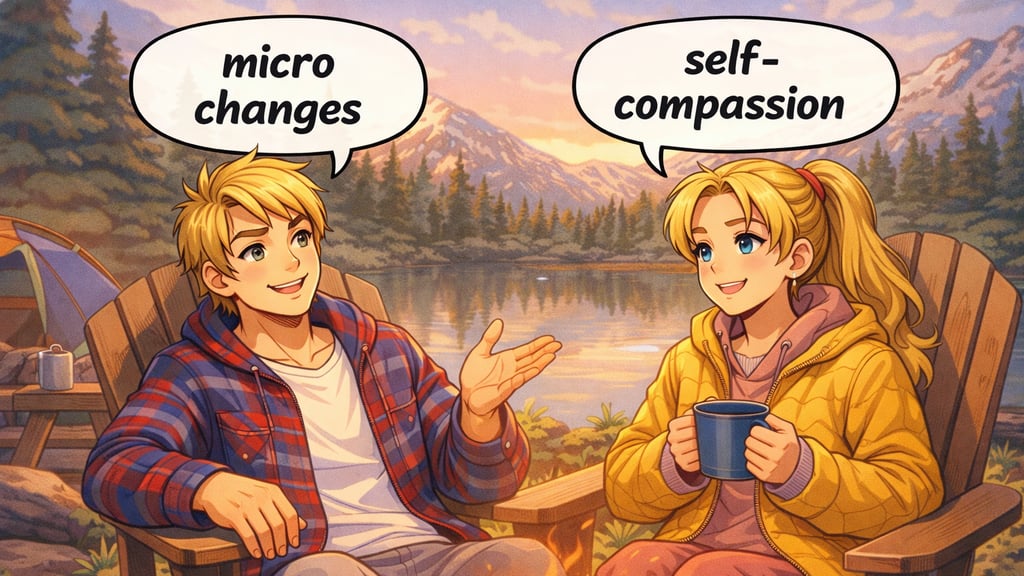
Chris & Jen in the Morning | Season 2, Episode 3: Feeling Stuck
Show Title: Chris & Jen in the Morning
Season: 2
Episode: 3
Title: Feeling Stuck Already? How to Reset Through Micro-Changes
Tagline: Where Self-Care Meets Real Life
Hosts: Chris & Jen
Producer Referenced: Ace
🎧 Episode Overview & Key Topics
**** Episode Introduction: Shifting from Large Overhauls to Micro-Changes
**** Gratitude Segment: Sunsets as Reminders of Fresh Beginnings
**** Friends as "Chosen Family" and Emotional Energy Vibes
**** Intrusive Thoughts, Insecurities, and Surviving a Wave of Aggressive Negative Self-Talk
**** Real-Life Vulnerability: Chris Shares His Experience at Universal Studios Orlando
**** The Danger of Post-Resolution Slippage and "Car Awareness" Traps
**** Neuroscience Nugget: How the Amygdala Treats Failed Intentions as a Threat Response
**** Breaking the Cycle: Relinquishing Self-Judgment as a Motivational Tool
**** The Binary Trap: Shifting the Goal from Absolute Perfection to Tangible Progress
**** Book Analysis: Healthy Inner Monologues in Mark of the Fool
**** Self-Compassion Strategies: Externalizing Your Inner Critic and Treating Yourself Like a Friend
**** Celebrating Effort Over End Results (and a Toast with Prosecco)
**** The Crucial Role of Self-Awareness and Trusted Circles Acting as Emotional Mirrors
**** Managing Anticipatory Anxiety and Flipping the Script on Intrusive Loops
**** The Binary A-to-Z Illusion vs. Pacing Milestones In-Between
**** Micro-Wins: Why Project Management Lists and "Agile Frameworks" Fail Personal Growth
**** Creating Tiny Reset Rituals and Navigating "8.5 Failures"
**** Embracing Shifting Shades of Gray: The Goal of Self-Response Over Self-Fixing
**** Closing Community Links, Professional Mental Health Encouragement, and Outro
📝 Full Transcript
- Introduction & The Micro-Change Strategy
Chris (00:00)
Welcome to Chris and Jen in the Morning.
Jen (00:02)
Where self-care meets real life. And I'm Jen.
Chris (00:04)
I'm Chris and welcome back to another exciting episode. We are going to have a conversation today around micro-changes because, you know, maybe as we've gotten into the new year we had those intentions or those resolutions, but we didn't quite meet them or maybe we're struggling with them a little bit.
Jen (00:30)
I mean, one month in... you know, no judgment.
Chris (00:33)
No judgment at all. Like, look, this is a—what do they say? This is a marathon, not a race? Like, pace yourself. And then kind of something birthed out of a real-life experience for myself, a little bit of how we can be kind to ourselves as we're hitting our groove towards these things.
Jen (00:40)
That's right. That's right. Oh my gosh, you know I love that. Just, I mean I do in spirit, but also I feel like that's what I'm constantly being told: "Be kinder to yourself." And I'm like, "What does that mean?" So I love that we're gonna talk about that today. I love that.
Chris (00:59)
"Stop it! That is not the advice I need right now." Haha! But as always, we will start with our gratitude moment. So would you like to go first?
- Gratitude Segment: Sunsets and Chosen Family
Jen (01:11)
Awesome. Sure, I will go first. So we're talking about a new year, the start of something new, and it really makes me think about why I love the sunset so much. And in part, it's like just the beauty. It's an artist painting the sky every single night in a way that I wish I could capture with paint and a paintbrush, and yet I was not gifted with those skills.
But I also love to watch the sunset because it is a reminder that no matter what is going on, the sunrise is coming. The sun always rises the next day. A new day always begins. And I kind of like that analogy in the context of the new year and this conversation we're going to have today because it's like, "Well, I screwed up today." That's okay, because the sun's going to rise again tomorrow anyway. And yet we have one more day to try it again, and you get as many do-overs as you get, you know? So, I just am really feeling grateful for not only the beauty of the sunset and the ability to go outside and watch them, and the time and the space that I've had this year to get reacquainted with the sunset... because you miss one and then there's another one right around the corner. But also that reminder in everyday life that the sun always rises.
Chris (02:18)
Yeah. That's right. That's right. And every day brings new opportunities. So we will embrace those as we continue through the year.
Jen (02:52)
We will. We will. What about you? What are you grateful for today?
Chris (02:57)
So I am grateful for the group of people who I would say are my core friends—obviously you and Ace, my husband Frank, obviously—but I also have a group of additional people around me who are close. And even whenever you're going through a tough time and whether you share it or not with people, I truly do believe you give off energy, you give off vibes, and people can pick up on that. And I think like, you're probably one of the better people in my life who pick up on that based on how much we talk.
And so I just appreciate whenever people like see you, they hear you, they check in on you, all of those things. I appreciate having a group of friends who meet you where you're at. And if you need a cheerleader, they'll be your cheerleader. If they need to carry you for a little bit, they'll carry you for a little bit. So super blessed for the friends that I have around me and the people that I like to call my chosen family, which include y'all obviously.
Jen (03:57)
I love that. I mean, community is so important, right? And I think who we surround ourselves with becomes the energy that we bring for ourselves. And I totally agree—I mean, we make ourselves better by being around each other. And I am incredibly grateful for that as well. So it's amazing.
- Deep Cut: Universal Studios & Intrusive Self-Talk
Chris (04:19)
Yeah. Well, so today's episode is kind of brought to you by intrusive thoughts, if you will. So we had talked in our new year resolution/intention episode about setting intentions and how micro-changes help instead of big overhauls and all of those things. And although I have things that I want to achieve—I have intentions that I want to work towards—I haven't put like, hard, fast deadlines or timelines to these things.
And I found myself this week struggling with a lot of like, negative self-talk. And I know that people have self-talk—I have negative self-talk as well. It is something that I think all people probably experience and you can, you know, have your coping mechanisms, if you will. But mine were probably the most aggressive that I've had in recent history.
So just to give a little backstory: A few months ago, Frank and I went to Orlando and we ended up having some free time, so we went to Universal Studios. While we were there, we enjoyed going on the roller coasters, the rides, things like that. For those of you who have not met me, who do not know the physical me, I'm a bigger guy. Like, I'm—I'm no tiny thing. And so some of the rides, I didn't necessarily fit into. And so I did have to go to the test ride seat, which is fine. Like, look, I rather you have that at the beginning so that I don't wait in that long line and then get to it and can't do it. Anyways, there was a really nice woman who I guess we were kind of all trying to get onto the same rides, who had gone through a weight loss journey, and she was just very kind and positive and very inspirational about things.
Fast forward to this last week, and I found myself—I had gotten down on the floor to pick something up, or I don't remember, I was doing something on the floor. But as I was getting back up, I just was like, "Oh my gosh, where's something that I can use to leverage? Where can I..." And then I just found myself like exhausted, winded, and I'm like, "Okay, I am not even like an older person. Why do I feel like I could be auditioning for a 'I've fallen and I can't get up!' commercial?" And then all of a sudden, the negative thoughts just started coming in a way that I wasn't prepared for.
Usually, I can pull myself back from things fairly easily and recenter myself, but I just found myself saying things to myself that I have never thought before—vile things. Like when you see abusive spouses portrayed on television, when you hear about stories of people who are in abusive relationships, I was saying that to myself. And it was alarming to me because I don't usually experience that level of what I would say aggression towards myself. Which then really got me like, "What are you doing? Like, great, you have this intention of wanting to live this healthier life, but you know, you haven't joined a gym, you haven't... what are you doing that's changing this?" [insert negative thoughts].
And so I was like, I can't be the only person who obviously is struggling with this and how it kind of feeds into this idea of what we talked about in that intentions episode. Like, wow, if I really get on board with these negative thoughts, it's going to take me into these negative places. I have not ever thought of myself as someone who eats to cope with my feelings or any of those things, but I can definitely see how it would have been easy to go and find some cake or go and find a slice of pizza to shove those thoughts, feelings, and opinions down on.
And so I wanted just to have a conversation around: One, why is it that we attach so much to these year-beginning intentions and goals, and we so easily let an inconvenience throw us into this whole whirlwind? And then all of a sudden we're not even our own cheerleader—we're not even trying to build ourselves up. In fact, my self-talk in that moment was tearing me down. So, not that I'm being vulnerable here, I am sure I'm not the only one who experiences this stuff, but I wanted to bring this conversation up because I do think like in this world, the first—as I was trying to figure out, okay, what is happening—the first thing that I identified was: Okay, where's this self-talk coming from? And why are we in this space? And why am I beating myself up over this?
- Insecurity noise & The Amygdala threat response
Jen (10:15)
I'm so sorry that you were struggling with that this last week. You know, yeah, I can relate. I can relate to that. For me, what has been tough about starting something and then feeling like you—like either you're more aware of it so all of a sudden... it's like buying a red car and then all of a sudden all you see are red cars on the road. Things that haven't changed, you just are more aware of, and so the noise amps up. But I think for me, sometimes it's about feeling insecure about the ability to change it. Like, will I actually be able to achieve this?
And I think that's why, for me, when you start something and you want to do it, and then you start to fall down or you notice—you start noticing more, so it feels bigger or more overwhelming—then you start to wonder, like, "How did I get here?" or "How am I in this habit?" or whatever it might be. And then like, "I don't even know if I can change it." And so often, whether we're talking about our physical appearance or whether we're talking about little habits that you create, it takes time to build those muscles or to create change. And for me, being a super impatient person, I want to see results right now. So often you don't see those right away, so it's really easy to fall into that discouraged space. I don't know if any of that resonates for you, but know that's how I feel—like why I get caught in the trap of beating myself up.
Chris (12:20)
Yeah, and I think what was surprising to me in this moment was it wasn't even something that I had—I hadn't set a specific goal like "I want to lose X amount of pounds by this date," and the actions that I was taking were not going to fulfill that goal. But it was like this... "I want to do good by myself. I want to be right by myself. I want to be right by my spouse." And you know, I just felt like in that moment, like all of a sudden, not only were my insecurities pinged—like if it were a button, someone pressed down and just held down, and it was like, holy smokes.
And so, I honestly can't even remember how I pulled myself back from it. And it maybe was like the startling, "Aha!" moment that, "What are you saying to yourself? Like, we don't say that to ourselves." And I was genuinely shocked at some of the thoughts that went through my head. And so it kind of brought me back a little bit.
And then, you know, we've been on this journey of embracing ourselves, self-care, trying to understand why our bodies and minds react in the ways that they do. And so as somebody who—I do not consider myself a control freak and do not feel like I need to be in control all the time—you would disagree with that? Okay. I was like, okay, what's happening? Like, where is this all coming from? And so I started looking a little bit more into like what the things potentially that were firing off in my brain when all of this stuff was happening.
Neuroscience Nugget: Shocker, we go back to that amygdala—always looking out for us. Basically, when we fail at an intention, the brain takes that as a threat response. And whether that's an intention, a goal, whatever we want to call it, it apparently does not matter. The amygdala will still react how it will want to react, and then that kind of triggers that negative spiral in self-talk and all of those fun little things.
- Dismantling Status Quo Judgment
Jen (14:59)
Yeah. Well, and I think oftentimes a way that we learn to motivate ourselves to create change—because change is not a comfortable thing, having to choose a different pattern, all those things—no matter how much you want it, it still can be uncomfortable. Because we're wired to kind of just follow a rhythm. And with change, you're disrupting the rhythm.
And so I think oftentimes to motivate ourselves to change, we have formed some kind of judgment about the status quo, and I think it's that judgment that we're using as motivation that also is really unhealthy. So what I know to be true is that you can love yourself, accept yourself, respect yourself, appreciate yourself just as you are, while also wanting something different—whether it's the way you physically look and the shape you're in, whether it's the choices that you're making about relationships or balance in life, or whether it's even like judgment about the talk inside your head.
But I think that's a really hard thing to do because oftentimes we motivate ourselves by trying to distance ourselves from the thing we no longer want, and so it's like placing this judgment on it. It's something that I really try hard to make myself practice, but it is not natural to me to try and say, "Okay, well, I don't like this, but that's okay. I still like me and I'm enough just the way I am, and changing myself is not going to make that any different, but it doesn't mean that I want to stay where I'm at." It's like, how do you break the cycle of the rhythm that you're in in a different way, instead of using that kind of judgment of the current cycle to propel yourself in a different direction? I don't know if that resonates for you, but...
Chris (17:31)
Yeah, I mean, like I said, I think this has really been a learning journey for me because I've not had—gosh, it wasn't as loud this time. Previously, it hasn't been as loud as what it was this time. And it was jarring.
- The Clean Start Trap & Mark of the Fool
Jen (17:45)
It was louder this time. As a lifelong self-judger who really struggles with those intrusive negative thoughts, I can relate. And it is tough. It's tough when you feel like you're—I mean, we say we're our own worst critic, but like truly—it's tough when you're putting yourself in this situation where no matter what you do, you're never enough. And I do think that when you set goals for yourself, like at the beginning of the new year, at least for me, there is this desire for like the clean, "Okay, I'm ready to make a change. I want a fresh start." And then when you start to slip back, instead of thinking, "But that's okay, you know, the sun always rises, every day is a new day," instead of thinking that, you think, "Well, I screwed it up and now I don't know if I can even do it."
Chris (18:43)
Yeah. Right, now you've—now you have fallen off course and you'll have to wait till the next new year. No, very much so not true.
Jen (18:54)
Yeah, which is not true. Yeah, I mean, we say things like, "It's not perfect, it's progress that we strive for," but like, let's be real—perfection's the goal. I mean, not out of ego. Not out of ego that I think I'm good enough to be perfect just because... I mean, for some reason, I am like wired in this way that anything less than perfect is failure, and failure is, you know, triggers the amygdala to go "threat!"
It really is just data about how to do better. We're reading this book right now—Ace reads out loud to us, and it is like one of the true gifts in my life because he has this amazing voice. And I'm trying to get him to read—like read stuff online because I'm like, everybody would want to listen to you and the stories that you have to tell. But we're reading this book right now: Mark of the Fool. It's a series, Mark of the Fool. And it's this fun kind of fantasy fiction book about like wizards and stuff. And in it, the main character does a lot of like self-talk and has really healthy habits for managing his inner monologue. And this concept of "failure is just a data point to learn from, to know what to do differently next time" is something that is just really interwoven in the book and comes up frequently. And I love this because not only is it this great story, but it's this almost subliminal messaging of reminding that like—
Chris (20:50)
Yeah, that's exactly what I was about to say.
Jen (20:54)
It's okay. It's okay to screw up, because the more you screw up, the more you know what could potentially not work out.
- Externalizing Your Inner Monologue
Chris (21:04)
Yeah. Well, and while I was like going through all of this, one of the other things I thought to myself was like, you wouldn't say this to one of your friends. Like if one of your friends called you and expressed this, you wouldn't say any of those words to them. Like, why would you say it to yourself? Having to—having to treat yourself with like, that—that self-compassion is, to me, like... I guess I didn't think of it so much as like a—had to be like an active thing that I had to make sure that I, you know, pulled myself back from, but it just goes to show, like it can—it can happen to anyone.
Jen (21:50)
Yeah, absolutely. You know, people that I care about and love and appreciate have been telling me to be kind to myself for a long time. And I think I've said before, I'm like, "What does that mean? I don't understand. How do you do that?" If I understood what I was supposed to do differently than what I'm doing now, I would be able to act on it, but I just don't get it. And what you just said is, I think, one of the really key ways to pull yourself out of that kind of self-talk and reframe it back.
I think we talked about this in one of our early episodes in season one—this whole idea of putting distance to reframe something, so talking to yourself like you would a friend. So you're taking yourself literally out of the picture and saying, "Okay, if my friend came to me..." let yourself go on the journey. What would I say to them? And then do the visualization every therapist is so fond of and speak to yourself and say, "Okay, this is how I'm going to choose to speak to you." And the more you do it, the more comfortable you grow with that because it's a skill that you have to build. It's not like a... you know, it's again—I feel like we say this so often, but this is a muscle. So many self-care, self-compassion, you know, mental wellness techniques are muscles you have to build.
Chris (23:21)
Right, and unfortunately, like it's not something that we are, you know... I mean, right, that amygdala is a real thing, and it identifies threats and it tries to keep you safe and—right, exactly. So, you know, I think as much as we can try really hard at being mindful of those things for ourselves, it's also a little bit of—if you are getting to curate the minds of tomorrow, be mindful of the habits that you're helping them build. Because who knows, maybe once they get to their late 30s and are inconveniently on the floor having to get up, it may be a lifesaver for them.
Jen (24:05)
I love that. I just know you were gonna say, "I'm not even in my 40s yet," and you stopped yourself.
Chris (24:12)
I just gotta—gotta pull myself back from that. Know your audience. Well, I'm not saying that that's old, because to me it was—it's not about like the age that I was, it was just like the...
Jen (24:15)
Wait, wait a second, wait a second, wait a second. I'm not saying that's—I mean, I'm not saying that's old, but... I know, I know. Wait, "I am only in my 30s. Why am I in this place?" Yeah.
Chris (24:33)
So yeah, it was not a fun experience, but it has created opportunities for me to learn.
- Toasting Effort over End Outcomes
Jen (24:41)
Well, and I think one of the other really important things that you can do—and this is something you have to continue practicing because it's something that builds on itself—is to celebrate your effort and not just the results. And so I happen to have a glass of Prosecco here. So I'll just cheers you and say, "Chris, I am so proud of you for acknowledging that you didn't like what you were hearing inside your head. And also for like, being vulnerable and willing to come share that and talk about that here in this space." But this is how you're celebrating—you know what, I need to make progress here. And this is something I want for myself. And I want to do it in a way that is positive and builds me up and doesn't tear me down. So while you may feel like you didn't like the place you found yourself in, this is effort and progress. And it matters. So congratulations, cheers to you.
Chris (25:40)
Thank you. Cheers.
Jen (25:45)
Delicious.
- Self-Awareness, Emotional Mirrors, and Anxiety Loops
Chris (25:46)
Alright, so now that we've talked a little bit about, you know, having self-compassion and thinking a little bit about what happens whenever we maybe are pulled off track, you know, what are some ways that we can like reframe and see these as opportunities? Because let's face it—rarely is there ever a perfect scenario where we are always going to be set up for success and we're always going to like check the boxes and be happy with our progress. Like, you know, being pulled off of the track you're on is very common in many of these circumstances. So have you ever found yourself like falling off the track that you are on and trying to like—how do you course-correct it while being kind to yourself?
Jen (26:39)
Oh my gosh, like daily! You know, yeah, absolutely. I think... it is—the first step I feel like is awareness. I say that all the time. I just wish I put that on a shirt: The First Step is Awareness. But I think the fact that you're listening and you're paying attention... like so often, people fall into this habit of just kind of skating through life and not really being present for themselves and thinking about what it is that they're doing. And so they're just kind of at the mercy of where, you know, the river of life is taking them. And I do think there is something to just kind of like letting life take you where it's gonna take you—there's a little bit of like, there's a lot of bit of like control freak in me that needs to let go of that sometimes.
But, you know, I do think that living life with intention is really important in finding happiness and getting the most out of the experiences that we have. And I think that the first step to intention and to change and to improving for the result of happiness—not for the result of success, but happiness—is having that awareness. I know sometimes I'm—one of the things that I've talked a little bit about this past year is I am really not always connected into the way that I'm feeling. I'm much more comfortable in that kind of cognitive space versus that emotional space, which is funny because I'm an expressive and I share things all the time, but I'm just like not always connected in there.
And so one of the things that this journey has taken us on is like, you say to me things like, "Jen, I noticed that when you say these things, when you say you're feeling this way, this is often like what's going on." And so you're kind of this mirror back to me for the things that I am not seeing. And so sometimes self-awareness is about tuning in and listening to yourself, but sometimes it's about having the people that you trust that you're surrounded with help be a mirror to you so you can start to be aware of where you're at.
And for me, that has really helped to kind of pull me back on track with, you know, like we talk about anxiety and managing anxiety. And you know, I want to go out and participate in a lot of things and then I get really anxious—that's not a new thing. That's something that I have always struggled with, but I didn't—I wasn't aware of that. I wasn't like... because I didn't think it was okay, I guess I just wasn't really tuned into that. And so now that I know what's going on, I can be more in charge of it and I can use it as a data point to figure out, "Okay, how do I manage this better so I can get more of what I want?" instead of like, "I want to go do this thing," and then we get all the way to the moment and then I'm like, "Nevermind. I don't want to go. I'm too stressed out." I can't tell you how many festivals I have wanted to go to that then I just don't end up going to.
Chris (30:02)
"I am beyond stressed." I do think when—like what you say is like that awareness of it, because I do think part of it is—I talk about like having a plan, and I think it is very important to have a plan, and especially like if you're trying to achieve a goal or an intention. But I do think like when—when you pull that stuff apart and you think of like, "Hey, well, if this is what I'm trying to achieve..." breaking it down into the bite-size pieces. So it's not like you're trying to, you know, achieve the big goal all in one sitting—like you're slowly chipping away at it. And it makes sense that, you know, when we're chipping away, if we chip too far one way or too big of a chunk comes off, like we then go into this like state of shock or scared or, "You know, I screwed up and it's not—I'm never gonna get it to look like how I want it to." Like, understanding that like, you know, sometimes it's the journey—it's the progress that you're making.
- The Binary Metric Traps (A-to-Z Illusion)
Jen (31:21)
Yeah, well, you talk about journey and progress. I think so often—I mean, whether it's talking about New Year's resolutions or whether, you know, goals or whatever—we set... we tend to set goals or resolutions or, you know, change or whatever like in this binary: I am here and I want to be there. And we don't set goals based on—we tend to not set goals based on creating change or the journey. And so we say, "Okay, if we take like weight, for example, I want to lose this much weight," or "I want to weigh this much," or "I want to be in shape," or "I'm to go to the gym, you know, five times a week, every week," or whatever it is, and you're starting at like a zero.
And so then you kind of—it's like implied for yourself that you're gonna get from A to Z with none of the other letters of the alphabet in between. And so then when you stop along the different letters, that's failure. And if we can frame up our change or our goal setting or all of that as, "I wanna get better at this, I want to grow at this," then you're framing it up so that you can start to celebrate that progress instead of celebrating the end result.
And I'm like—this is something that my whole life I've been terrible at. It's like, I mean, from a work standpoint, early on, people used to say like, "You would just have such high standards and it's really hard to make you happy." And it's like, "Well, yeah, we're here, we need to be there, and we're not gonna celebrate until we get there. Like, why would I celebrate the wins along the way? Because you didn't make it, you know." Obviously I've grown a lot through my time on this earth, like that's—that is like... you got to use a lot of grit to make it through to the end without celebrating the progress along the way. So instead of saying, "Here's where I want to be," you can still say that, but your goal should be, "I want to work towards this." And it's not letting yourself off the hook—it's like being kind to yourself and recognizing reality is you're not going to run a marathon without first getting to a 5k.
Chris (33:47)
Right, exactly. Like that's the—you know, everything in between A and Z.
- Goal Reframing & Planning to Fail
Jen (33:52)
Yeah, a thousand percent. So like I had kind of joked and said, "I want to eat more veg-forward"—like, I want to eat more veg-forward versus like something else that feels unattainable, you know, is probably a better path to success. And I got to be specific about what that means so that I can hold myself accountable to it. But, you know, I think it's all in how we frame up the goals that we set for ourselves. So whether it's like weight or eating or balance in how we spend our time or, gosh, I don't know, Chris, positive self-talk. Like if you say, "I have a lot of negative self-talk and so I don't want to do that anymore," like, you're gonna fail. So you just need a plan to fail at that. And you plan to fail by saying, "You know what, I want to have less negative self-talk, and I want to be better at acknowledging it and not sitting with it—like stopping it and flipping it or counteracting it."
You know, one of the things I like to do when I'm having a lot of negative self-talk is affirmations, because sometimes I can't find my own words—they're all really nasty. And so I'm going to use somebody else's words, or I'll call you and say, "Chris, like, I need you to say nice things to me."
Chris (35:22)
"I need—I can't say it to myself, so I need someone else to say it."
Jen (35:25)
Ha! Yeah. I mean, it takes a level of vulnerability, right? But I think those are some of the ways that you can cope with that. But you have to plan to fail, and that's how you succeed.
Chris (35:43)
I do think there's this idea of we have to re-anchor ourselves whenever we do feel off track. And I think that's a lot of what you're talking about—is understanding that you are likely going to be pulled off track. But whenever you do, what are those barriers, if you will, that are going to help guide you back into that center lane and help you continue? Like, not continue driving off the road, but kind of bring you back onto that path that you're trying to ultimately get to your destination and find your way there.
- Project Management vs. Personal Growth
Jen (36:19)
Yeah. I think in this conversation, I've just had an epiphany about what perfectionism is and what self-compassion is.
Chris (36:28)
See, that was not—that was not the goal of where we were headed, but it's an understanding. And I think—I think that's what a lot of this was also for me as I went through—was that, you know, as we go through life and anything that we're trying to achieve, whether it's that New Year's intention, resolution, whatever, just a goal that you have for yourself throughout the year... it's not always going to be easy, it's not always going to work out exactly how you think. And I love how you talked about like, you know, we—we try to get to A to Z without having to go anywhere in between. But also like, we don't celebrate those things. Like, whenever we do get from A to B, isn't that a celebration? Like, that's a step in the right direction.
Jen (37:18)
Yeah. Well, and I think we have grown up in a time where it's like people say, "Well, gee, participation gets a trophy." And, you know, it's like—what that sometimes implies is like getting from A to B shouldn't be celebrated. But like, of course it should! We should always celebrate milestones.
And, you know, I was telling you this past week, I think I'm a terrible list maker and I figured out why. It's because when I make a to-do list, I put too many things in one item. And so I'm like—my item is like, "Build a website." And that's like a 75-step process, but I can't cross it off my list until I've completed it. But then like, I end up with Post-it notes of lists of uncrossed items because, you know, I put too many things and I didn't put any of the milestones in.
Chris (38:04)
Exactly.
Jen (38:19)
So every project manager that's listening is just like, cringing. Like, "I know you're not a project manager!" Because, you know, I think we do tend to oversimplify what it's going to take. It's my optimism. I oversimplify what it's going to take to get from one to the other. I'm impatient, I want to have it now, and I've set myself up to be unhappy. And then like, that's a loop that just feeds itself because you're just proving to yourself that you can't do any better, versus setting yourself up with small goals of like... an "agile framework," to bring in—everybody loves that, so it's so corporate-y here!
But you just take little bites, little bite-size wins, and you know where you're headed because you need to be able to stay on track so you don't just get caught side-questing. You're really focused on what's right in front of you instead of just focusing on the very end, and then, you know, it feels like it's forever and you get overwhelmed and you feel like, "I'm never going to reach that goal." I mean, if you think about it, when, you know, somebody is dealing with addiction and they're, you know, going through those programs—they're all designed about like, just today, not, you know... and, and you celebrate with your like, "I got my, you know, one-year, my two-year, my three-year," even smaller than yours, you know, because it is really important to celebrate the small wins.
Chris (39:57)
For sure. And I think that's what we have to like—build that within ourselves. Like, hey, we—using the example of like, "I want to run a marathon." Well, if you've never run a marathon before and you're not a runner, like, you're not going to get off your couch and go run a marathon. You got to—but like, you have to—you have to get off the couch and maybe like, you know, take a round around the block. Walking, maybe. You just decided to keep running.
Jen (40:19)
No, you'll die first. Unless you're Forrest Gump, in which case you just decide to start running and then you run around the world. Yeah, but none of us are Forrest Gump, so...
Chris (40:37)
No, not anywhere near it. But I do think as we try to create those habits and those routines, we have to reward ourselves and we have to acknowledge the successes that we have made in that journey from starting at A and trying to achieve our end zone at Z.
- Tiny Reset Rituals
Jen (41:00)
Yeah, absolutely. You know, so, okay: You're in the middle of it. You're headed from A to Z. You're trying to get just to B—from A to B. You've acknowledged that you're going to celebrate once you get to B, but before you arrive there, you're at 8.5 and you fell off. What—what do you do?
Chris (41:20)
Oh no!
Jen (41:26)
So I think the concept of returning to intention with kindness—like, being kind to yourself—what does that actually mean? Like, having tiny reset rituals you create for yourself so that you can take a mindful breath. You maybe have some affirmations already queued up that will give you the words when you don't have your own. You have your trusted few people that you can call and be vulnerable with and say, "I screwed up and I don't want to be judged for that right now. I just need you to say something nice to me." And then they're not going to judge you for doing that. Maybe there's like a journal sentence or something. I think those are some good ways to get yourself back on track. What else? What do you do? You—you talked about having these negative self-thoughts and then not staying there. What did you do?
Chris (42:23)
Yeah, I mean, I think a lot of—we've talked previously about how, like, I do have a very loud, like, self-internal dialogue. And so usually, like, I can figure out like what's happening and can adjust accordingly—whether it's reframing something as like, "Well, I totally screwed that up and like, way to go Chris," into, "Okay, but what did we learn from that? Like, how—like what are the things that we can learn from that?" I think in the instance that—
Jen (42:54)
Future Focus.
Chris (42:54)
Right, exactly! Like, let's not—let's not linger on the failure, but what did we learn from it so that way we can—we can put it into that next space. So I do think in—gosh, in this journey, what it has taught me is that I can be hard on myself in a way that I was not previously aware of. I just like got to a place where it was all of a sudden like, bam! And it hurt. Like, it was—it was a, you know, hurt the ego from a, "Wow, like, you—you didn't achieve something," or it, you know, fell off. And then you're in this place of like, I'm saying all of these terrible things about myself, and they're things that like, I don't believe in. Where is that coming from?
So I think like, there was a little bit of fear there too, like, "Ooh, this is new. Like, where have these things come from?" And so having to like, peel back and see where all of this stuff is coming from and making sure that I'm paying enough attention. So I think a lot of what I used was a lot of like reframing tools to try and move myself out of staying in this negative self-talk and trying to figure out like, "Okay, well, we know this isn't true. We don't fail at everything we do. We're not a screw-up. We're not—we're not unworthy of something. Why are you feeling this way? Why are we saying this to ourselves?" And I do think some of it is like that deep introspection that you have to do. That's not always the fun work to do.
Jen (44:36)
Gosh, the journaling, the meditating, the sitting with oneself... yeah, love all of those moments.
- Moving Away from "Self-Fixing"
Chris (44:40)
Right. And yeah, and then accepting like, not everything is black and white. As much as we would love to put things in boxes, keep it clean, keep it easy, keep it organized... like, life is messy.
Jen (44:54)
Oh my gosh, I say all the time—Ace can attest to this, probably wants to like sit me out on the porch every time I say it—but I say it constantly: Like, it's not binary. It's not one or zero. But so often we do, we make things into this like a binary one or zero, yes or no, black and white. And the reality is that like life is just a bunch of shades of gray.
Chris (45:08)
Yeah. Yeah. And I think like, the other thing that I learned through all of this is like—this isn't so much about like, fixing myself. It's more about changing how I'm responding to myself in instances, and trying to not just disregard the internal talk, but try to like understand it, where it's coming from, and work through it. So that way it doesn't come back louder and meaner.
Jen (45:36)
Yeah. Yeah. Well, I really appreciate you sharing that. I know this is something—like having positive self-talk is something that I struggle with. And it's something that, you know, I really work on, but it's something that all of my life has been just a really tough thing for me. And, you know, I know that making it safe to say that that's something that you struggle with by seeing other people who also struggle with it is like really helpful and important. So thank you for like, being vulnerable and for sharing that—I think it's so relatable. You know, we all have those moments where we want to change something and we just feel like we tried and then we screwed it up. And so, you know, should I just give up? No, don't give up. You're just at 8.5.
Chris (46:48)
And you have so much further to go, and you're gonna make it.
Jen (46:51)
Yeah, absolutely. And be kind to yourself along the way because, you know, as Miley would say... it's the climb.
Chris (46:59)
It's the climb. It's the climb. Well, thank you so much for, you know, allowing the space for us to have this conversation. Like I said, I know that like everyone has self-talk—I myself have self-talk—but I don't know, that day it just seemed like louder and meaner than it has ever been.
Jen (47:20)
Well, I'm really proud of you for talking back. I mean, they say it's not a great thing when you start talking to yourself, but I actually think it is. It's really healthy.
- Closing Community Outro & Resources
Chris (47:23)
Hahaha! Well, thank you. Thank you for seeing me and thank you for hearing me. So, I don't know—like, I'm sure other people have been on this journey. If there are things that like resonate with you or things that you have found to be helpful, we'd love to hear from you. Please, depending on what platform you're listening to us on, you can share those in the comments. If you are hearing us on a platform that doesn't have comments, you can always email us at connect@chrisandjenitm.com. You can also on our website find a little "contact us" type form, and that's chrisandjenitm.com. And you can always call or text us at 940-278-8129.
I do just want to say like, we are not perfect at this obviously, we are on this journey ourselves. And if you don't feel like you are able to pull yourself out of this, or that self-talk is just extremely loud and much more persistent than what you feel it should be, you know, we highly encourage you to seek the help and advice of professionals. We both truly believe in the professionals that we engage with, and you know, it's not something to be ashamed of—it's something to be celebrated.
Jen (1:05:20)
For sure. Absolutely. It's part of being kind to yourself. Well, until next time, truly be kind to yourself and to one another, and let's make it a great week.
Chris (49:04)
Bye everyone.